
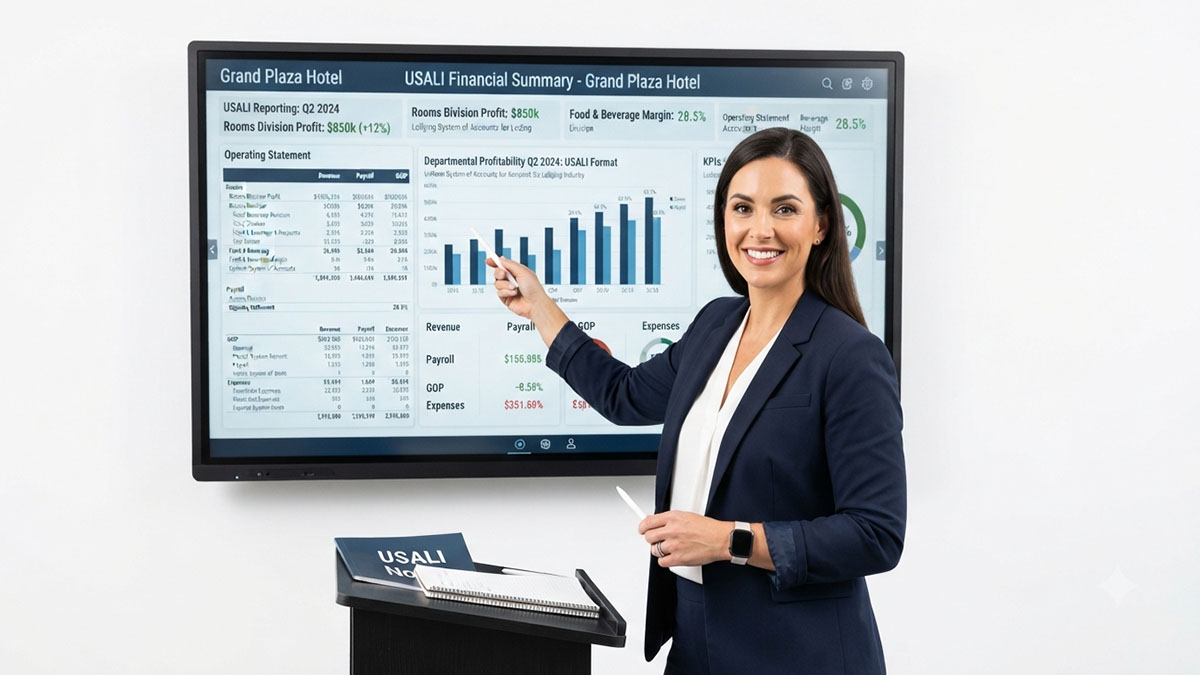
Managing a hotel or hospitality business successfully requires a deep understanding of daily operations, guest satisfaction, and most importantly, meticulous financial oversight. In the competitive lodging industry, property owners and financial controllers face unique challenges that go far beyond standard corporate accounting. From managing fluctuating room occupancy and food service costs to handling multi-departmental labor expenses, keeping track of cash flow can quickly become overwhelming without the right framework. This is why standardized accounting practices have become the gold standard for hoteliers worldwide, providing a common language that simplifies complex data and drives smarter business decisions. If you want to elevate your property’s profitability and ensure your accounts align with global best practices, mastering financial reporting for hotels under USALI is an absolute game-changer for your management strategy.
To truly appreciate the value of this specialized accounting method, we need to look at how hotels operate compared to traditional retail or office businesses. A hotel is rarely just a single revenue stream; it is a complex ecosystem made up of multiple operating divisions. You have the rooms division, food and beverage outlets, spa and wellness facilities, parking services, and administrative overheads. Each of these departments functions almost like an independent business operating under one roof, generating distinct revenue while consuming specific resources. If an owner tries to track all these moving parts using generic spreadsheet templates, discrepancies are bound to occur, making it nearly impossible to identify which areas are thriving and which are draining capital.
The Uniform System of Accounts for the Lodging Industry was created specifically to solve this operational complexity. By establishing clear guidelines on how revenues and expenses should be categorized and reported, this system brings absolute clarity to hotel finances. When department managers, general owners, and outside investors review statements structured under these guidelines, everyone speaks the exact same financial language. You no longer have to guess whether a specific maintenance cost belongs to property operations or administrative overhead because the rules provide a precise, universally accepted blueprint for every line item.
One of the greatest benefits of adopting this structured approach is the massive improvement in departmental performance tracking. When you review your monthly profit and loss statements, you want to see exactly how profitable your food and beverage department is on its own, independent of room bookings. Specialized reporting breaks down operating statements into intuitive schedules that isolate each revenue center. This level of granular visibility allows management to spot inefficiencies immediately. For instance, if labor costs in the housekeeping department start creeping upward disproportionately to room turnover, the reporting framework highlights the issue instantly, allowing leadership to adjust schedules before profit margins take a hit.
Furthermore, implementing financial reporting for hotels under USALI plays a critical role when seeking external financing, bank loans, or attracting new investment partners. Financial institutions and institutional investors are inherently cautious and demand absolute transparency and standardization when reviewing property portfolios. When you present financial statements that strictly adhere to globally recognized lodging standards, you build immediate credibility. Lenders do not need to spend weeks decoding your unique internal accounting methods; they can instantly verify your gross operating profit, occupancy trends, and cost efficiency ratios, which drastically accelerates loan approvals and partnership agreements.
Benchmarking is another powerful advantage that comes with standardized accounting. Running a hotel in a competitive market means you always need to know how your property stacks up against regional competitors and broader industry averages. When your internal reports match the format used by major hotel brands and professional management companies, you can conduct apples-to-apples comparisons. If your utility expenses are significantly higher than the regional benchmark, you know immediately that it is time to invest in energy-efficient lighting, upgraded HVAC systems, or better insulation. This turns raw accounting data into proactive, strategic intelligence that protects your bottom line.
Budgeting and long-term forecasting also become significantly more reliable when grounded in uniform accounting principles. Hotel demand is notoriously seasonal, influenced by holidays, weather patterns, economic shifts, and local events. By analyzing historical financial data categorized correctly across all departments, your management team can build highly accurate forecasts for upcoming quarters. You can anticipate upcoming slow seasons months in advance, plan major room renovations during low-occupancy periods, and allocate marketing budgets precisely when they will yield the highest return on investment. This shifts your operational style from reactive firefighting to calm, strategic long-term planning.
As technology continues to advance, modern hotel property management systems and accounting software are increasingly designed to integrate these standardized reporting structures automatically. Automated data collection drastically reduces the risk of human error during manual data entry, ensuring that financial statements are updated in real time. However, software is only as powerful as the framework behind it. Pairing advanced cloud-based financial technology with established industry guidelines ensures that the reports generated are not only fast and automated, but also fully compliant, meaningful, and ready for executive review at a moment’s notice.
In conclusion, achieving lasting success in the hospitality industry demands a rigorous, professional approach to financial management. Relying on outdated, ad-hoc spreadsheets leaves too much room for error and hides valuable insights that could drive your business forward. By transitioning to standardized frameworks and utilizing professional tools focused on financial reporting for hotels under USALI, property owners and financial controllers can unlock new levels of profitability, operational control, and peace of mind. Embracing these industry best practices today sets a solid foundation for a resilient, highly competitive, and financially secure future in the ever-evolving world of hospitality.
Why Modern Hoteliers Rely on Specialized Frameworks
In today’s fiercely competitive tourism market, running a hotel purely on gut feeling is a recipe for financial stress. Travelers today have endless accommodation choices, online reviews can instantly impact your booking volume, and operating costs like utilities, insurance, and employee wages continue to rise. To stay profitable, you need to squeeze maximum efficiency out of every single square foot of your property.
This is precisely why professional management teams depend on structured financial reporting for hotels under USALI to monitor their daily, weekly, and monthly progress. These specialized reporting guidelines are designed exclusively for the lodging sector, neatly dividing your financial data into clear operating sections. They separate your direct revenue-generating departments from your undistributed operating expenses, such as administrative overhead, information technology, sales and marketing, and property maintenance.
By separating these costs, you gain a crystal-clear understanding of your true Gross Operating Profit. You are no longer just looking at total room sales and hoping for the best. Instead, you see the exact net contribution of every single department after accounting for its direct labor, supplies, and operational overhead. If your front office expenses are creeping upward due to inefficient scheduling software or poor shift management, your detailed departmental reports will highlight the issue instantly, allowing you to fix the problem before it eats away at your monthly earnings.